• The house was a cute cottage style place that had white clapboard sidings and a black roof. The lawn was slightly overgrown but nothing that made me think that it was vacant. I knocked on the door, but no one opened it.

    I could see through the window beside the door that there was someone in there. I knocked again to get their attention and they jumped as if startled and then turned to look at me. Their eyes looked large in the shadows. I could see them fluttering their hands about.

    I tried the door and it opened under my hand. I stepped in and smelled a strong odor of garlic and roses. The person I saw through the window was there, staring at me. She was an older woman with grey hair piled up into a bun or maybe it was just a short hair style, I couldn’t tell. She had glasses that were really large that made her eyes bigger. I introduced myself, but she said nothing.

    She then turned and went through a doorway. I quickly walked through myself into another room that was dark. It was hard to see the furniture and junk about so I made my way slowly. Suddenly there was a burst of light as the back door opened and she went out. She left the door open.

    She made tracks in the snow, big black holes that spoke of her direction, and I could see her bounding away like some kind of startled deer. I followed because I was concerned—she was bare footed and I could see the marks of her toes in the snow. Walking on snow barefoot is very slippery and I saw her fall several times.

    Soon she was at the shore of a lake and she began to venture across the ice. Here the snow gave her a bit more grip so she could move faster, bouncing away like a white hart. Then the ice cracked and she fell in.

    I grabbed the bag slung over my shoulder and used it as a lifeline for her to grab. She didn’t reach out for it. I pleaded with her to save herself and she just smiled and pointed back upon the path we had just come.

    There were only my tracks in the snow and through the house. I walked quietly back to my car with the whispers of a truth that I had only been able to see but not catch.
  • I approached the house at night. It was a dark house, but once I got close to the front door I realized that there was some light seen from a room in the back accompanied with the flicker of an active video screen. I knocked twice and a older man approached the door.

    He turned on the porch light a peered at me through the storm door. I showed him my credentials and explained the purpose of my visit. He seemed interested and invited me in.

    The home was well maintained and appeared occupied only by adults. I was directed to the room in back, which was a kitchen area with a bar setup. The man indicated that I should sit at the bar, so I did. In the room was his wife, who also seemed interested.

    Before I got to asking my questions I explained the nature of the survey in detail. That started prompting questions—things like what kinds of questions I would be asking and who uses the data. I was able to answer the questions easily and things were going smoothly. Then the woman announced “I am not answering any questions.”

    Her husband seemed befuddled. I could tell from his questions and body posture that he was on board, however his wife’s refusal made his cooperation a moot point.

    I pressed and she simply explained that she did not trust the government and that she didn’t want people all up in their business. She went on to say that sometimes it was a good thing to not know things. I tried from one or two angles but she was not budging. I then made a somewhat awkward exit from the house.

  • It was a sunny afternoon in early autumn, and I approached a house in an unincorporated suburban area. Respondents in unincorporated areas have their own stereotypes and so I had an idea what to expect.

    Unincorporated sounds like a precise legal term but it’s actually a generalized description of a neighborhood that varies widely depending upon location. Where I typically work the layers of government are very complex to the extent that a property can be within a school district or library district but not within a municipal district.

    These types of properties often have less regulation then a typical residential area. They may allow livestock keeping, like chickens or pigs, and be loose with things like wheeled recreational vehicles used as secondary residences. A common identifier is the presence of a well and septic system as opposed to regular water and sewer service.

    This particular home was in such an area, albeit in a higher income area, hence the absence of junk and active farming. I didn’t see any fire hydrants so it was likely on well/septic. The house had impeccable landscaping but was outwardly modest.

    The garage door was open and there was an older man puttering about. He looked kind of battle worn, but had the light of interest in his eyes when I made my pitch. He immediately retorted with a conservative political viewpoint—that is he questioned the overall integrity of the data I was proposing to collect. I easily deflected such a retort as it is imperative that I remain politically neutral in my data collection and secured his cooperation for my survey.

    He answered my questions thoughtfully. Once I was done I went back to his initial point and, with a lot of respect heaped on, readdressed his initial retort. I gave a much fuller explanation of my employer’s policy in the issue and described the importance of the non political aspect of collecting data versus the political aspect of using the data collected. He conceded my point.

    With that we ventured into a topic of contemporary American politics. We talked about a few issues of the day and I found that my respondent was well versed on conservative talking points found in the media. In listening to him I realized how the constant repetition of opinion represented as fact was crippling his ability to comprehend the other side’s position. I would cite a broad topic and he would quickly focus on a specific aspect of that topic and cite that example as justification for his position.

    I can explain this as a generic example by using food stamps. I would say something like ‘Don’t you think it’s it’s a good idea for the government to give food stamps to low income individuals?’ and his response would be him citing examples of food stamp fraud, where he had heard a story about a welfare queen who had used her food stamps to buy a Mercedes SUV.

    We spent twenty minutes or so bantering about talking up such issues in his driveway. I then told him I had wasted enough of his time. He told me he didn’t consider it a waste at all and that he had enjoyed my company. We talked for a minute or two more afterwards about the importance of listening to people.

    I went back to my car and wrote up my interview notes as the afternoon sun came down and a slight breeze had the leaves in the trees talking about upcoming color explosion.

  • I was working a survey that had an interesting method of identifying the respondent via a preliminary set of questions. So basically, I'd approach a house, gain the cooperation of someone there, obtain a list of the residents in the household, and then the computer would identify the person I would interview.

    I approached this house the first time, and an older balding man answered the door. I started to explain why I was there and he angrily dismissed me. He wasn't having anything to do with any surveys.

    I made note of his refusal and the time that I was there. A few weeks later, as my case load shrunk, I decided to do a visit at a different time. Then a woman answered the door and quickly agreed to go through the screening process. She lived there with her cranky husband and an adult daughter. Of course the computer selected the old man. His wife went into the other room where he was watching tv, and told him about his selection. She came back a few minutes later and said that he wouldn't do it.

    A week or so later I went back because. This time it was early afternoon, and he answered the door. He looked at me with a defeated look on his face and told me that he needed to be quiet because his grandkids were sleeping. He told me to return on a different day.

    When I arrived at the appointed time, he greeted me warmly, He led me into his kitchen and offered me iced tea before I started my survey. Through the interview I learned that he was a retired doctor—no stranger to helping people and fully aware of the vital importance of my survey.

  • So I don't hitchhike anymore because I'm old and whatnot but once in a while I still end up touching the road. One day I was involved with teaching a class for election judges. This class took place in the county complex—a collection of buildings including the administration center, the county nursing home, the health department, highway department and the county jail.

    I had worked in that complex for many years as a regular employee in the administration building and so was familiar with what went on in that campus. For my training session that night, I got there around 6 or so, helped set up for the training, and then spent several hours trying to teach volunteerish judges how to run an election. Once done, I then helped clean up and reset machines for the next training session.

    I walk out around 9:30 or 10 pm or so, a time in which the complex is pretty much deserted. I get into my car and start it up and then notice that there is someone walking towards me. I immediately noticed that he had an old-style paper grocery bag carefully folded—something that I recognized as a bag given to those recently released from jail. As he got closer he started shouting. I rolled my window down to listen. “Are you my Uber?” He was saying.

    I denied this as I won't have anything to do with Uber. He then went into somewhat of a plea for a ride. He immediately made reference to a part of the county that was on my way home, albeit with a slight detour. So I had him get into my car.

    He eventually explained that he had been arrested on a suspended license type charge with some other vague issues. Having had my own experiences with legal issues and incarceration I recognized that he was embellishing his situation to make himself innocent. I was polite in reserving my judgment as I wished to only grant him the mercy of immediate transportation. Otherwise he was walking.

    It also reminded me of another time when I was hitchhiking. Except in this case I was trying to get to a nearby train station and the shuttle bus I usually took opted not to run that afternoon. So I found myself hitchhiking while wearing a tie on a suburban street. I got a ride pretty quickly and made my train. My benefactor said he knew I hadn't come from the jail because there was a big sign at the exit saying hitchhiking was forbidden.

  • I had been given several addresses within a single deep inside a disadvantaged urban area. The notes from the previous interviewers all indicated that the doorman was refusing them entry, and with frustration and fear from the nature of the slum in which this building was in. I drove there in the late morning of a bright sunny day to get a look at the situation.

    Of course, despite the heat and early day there were many people idling about doing what people do in poor areas. I parked my car and approached the building which had a wrought iron fence surrounding a small yard paved in concrete and asphalt. There was only one entry was through a gate and up some stairs. Then I noticed that there was an old woman—who appeared to be at least 80 was pulling weeds inside this enclosed yard. She was, strangely enough, of my race, as opposed to all of the other individuals I saw in that neighborhood. She noticed me and asked what I was doing there in heavily accented English. So I told her.

    She nodded, opened the gate and said 'Follow me.” She charged up the stairs and went into the building with me following. Inside I saw the manned security desk that had stopped the other interviewers and at least 6 people loitering in the lobby waiting for something or other. My new guide charged through this security point without stopping and I simply followed.

    The hallways were kind of dark and cool, with a faint odor of marijuana and a symphony of television and radio sound snippets. We went up a flight of worn stairs and down stinky hallways to the door I needed to visit. I knocked on the door while she waited patiently, but no one answered. She muttered something and reached for a big ring of keys. “Do you want me to see if he's there?” She asked. I refused and told her that I had it under control and could do the rest of my visits without her help.

    I ended up working several apartments in that building and returned multiple times, including some evening visits. I never saw that woman again but from then on when I walked in the lobby I was immediately granted access.

    (Title is from an unpublished poem and has no  actual reference to a specific location)


  • It was a home that was likely built in the early 1900s—before the depression of the 20th Century. In some towns it would have been called a painted lady. It was three stories tall and had a large wrap around porch beside the front door.

    This wasn't a cold visit—I knew the name of the person who I was supposed to see and I had a list of tasks that I needed to do for them. I was working for a social service agency and was performing various chores for elderly clients. I had been told that today's client was blind.

    And so she was. A pleasant woman who lived in that large house all by herself. She was pretty blind, but could see well enough to putter around the house. She needed help with some tasks that required sight as well as someone with a strong back and hands. While I worked for her we talked.

    She told me of her life, how she came into the house and how the grand kids loved running about when they visited. They didn't live close by so she couldn't be with them as much as she wanted. She also liked to cook. As my tasks began to wind down she invited me to have some lunch.

    The lunch was awesome—some roast chicken and stuffing, collard greens and mashed potatoes. Being quite the hungry young man I was always in favor of free food, especially home cooked food. I dug in as she poured me a glass of lemonade. Then she said “Oh, I forgot the bread!” She got up and went over to a plastic bag where she retrieved two slices of bread and placed them on a plate that she set before me.

    It was slices of white bread from a well known company, except the slices were no longer white. They were a startling blue/green color of a mold garden. My eyes went to the stuffing on my plate, and I realized that it was likely made from that same bread.

  • The house I was supposed to go to was one of those Victorian style painted ladies—a large home build a century ago with a large porch, rounded windows and piles upon piles of roofs and windows. Like all painted ladies she was past her prime and had succumbed to the plastic surgery of subdivision. And so it was number two I knocked on.

    A woman answered. She obviously was born in the last century and the wool knit cap and colorful shirt she wore told me she was of the hippie mindset of the 60s. I asked her my questions and she gave me answers. She was pleasant and I began to wonder what she was like when she was younger.

    “You know,” she said, “I have figured out the place for God in one's life.”

    “What do you mean?” I asked

    “You see, God is the barrier between the self and not self. Imagine that one is in a sphere. At the core of the sphere is the self, an entity that contains all of the elements of the sense of self one has, including the things that the self perceives around them.”

    “Kind of like a planet, you mean?”

    “That would be a good analogy.” So the self is planet, mostly inside, but with an exterior exposed to the atmosphere. The atmosphere would represent the world we perceive outside of ourselves, including other people and the physical conditions around us.”

    She paused and then continued. “In this case, God is the blue sky above us. When we stand on the suffice and look up all we can see is God, because God is shielding us from the unknown. If we blast off from the surface in a rocket, then the blue sky begins to fade. Once we get beyond that, there is no more God, just space.”

    “So there is no God in space?” I asked.

    “Only the God you bring with you. If you are able to expand your planetary view to go beyond God, then perhaps. But regardless of what you believe you still have to break through that blue barrier. And even if you do, It'll still be likely to be with you because you will have remembered that it was there at one time.”

  • So maybe you're driving along some highway and you pass by someone's house. It might be sitting in the middle of an empty field, past it's best days and now simply struggling to keep it's occupants safe from the elements. Or maybe it's a city and you can see rows and rows of apartment towers that look identical standing tall in the sunlight. Or maybe it's that house across the street where you never see anyone.

    So you wonder what's going on inside. What does it look like in there? What do the people who live there do? How can they live in someplace that seems so different from what we know.

    Sometime when I was a teen or almost so I discovered the idea of truth. I learned that it was a powerful word, a representative word and a descriptive word all wrapped into one. I first compared the concept of truth to the theology I learned while being confirmed as a Christian. I trusted that Jesus was the truth and learned his lessons and took his message into my heart. The seed that was planted grew and soon I found that the terrarium I had built couldn't be contained by the walls of Christiandom and so I began to explore options.

    Perhaps, I thuoght, I could embrace anti-truth, an ideal, to me, that represented evil. So I did. I was mean. I stole. I hurt others. I killed.

    Maybe I thought that such acts would chase the truth away from me and I could go on to live my miserable life in peace. But that was not the case. No matter how hard I tried, no matter how casually evil I was, I could still see that truth off in the distance, just out of reach but never out of view.

    I've moved beyond that and just am me. I know that some people will view me as evil and I accept that role in their perception and only wish to aid them in their understanding of the issues at hand. Sometimes evil can reveal truth if one examines it closely. Of course the concept of truth within acts of compassion and love are much broader in their displays of truth, although an argument could be made that the truth in altruism can be deluded by volume.

    So all that's left is memories. I will leave them here.

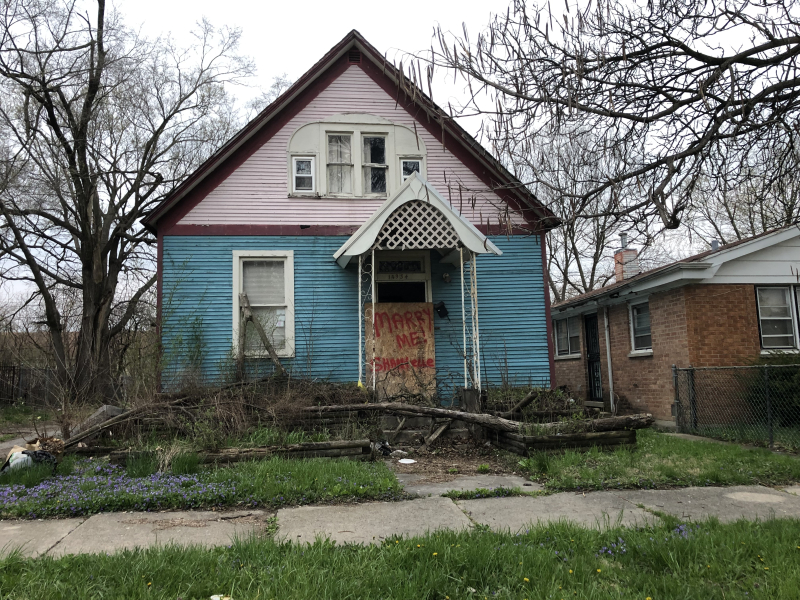
  • Hhouse1


    So this is a photo I took a couple of years ago while working one afternoon. It's just a single abandoned home with a marriage proposal. I doubt the person who lived there wrote the message, but I suppose it's possible.

    It's kind of hard to look at this house and see the vibrant colors slowly fading, or overgrown lawn. I didn't look too carefully on the sides and the windows seem intact so I assume that this could be rehabbed into something livable again. From the style of the architecture and the area it was in, I'm guessing it was built sometime between 1950 and 1970.

    Obviously there was a time when the people who lived here called this place home, and would eagerly return every evening, knowing that they had this little piece of sub-urban paradise. I'm sure there were other times when the house brought pain because of hostile or violent families, or the death of a loved one or even some personal agony over love lost or found.

    What makes this picture more noteworthy is where it was taken. Here, you see two houses—one abandoned, and another that was not. It's not quite clear but the brick house next to it was kept up and appeared to have people living in it. These two houses are but two of many in a small suburb near Chicago. The abandoned and vandalized house was one of many. In that particular area, about half of the homes were in an unlivable state, due to fire, vandalism or lack of maintenance. Those homes were scattered throughout the town, and often right next to homes that had well manicured lawns and were well maintained.

    And it's not just houses that are like this—there are apartment buildings and storefronts in the same condition. There was even one intersection that had abandoned commercial buildings with apartments on top … on all four corners. The scene of urban decay was staggering and I wished I took many more pictures, but I refrained because it wasn't safe for me to do so. It was okay for me to drive around the neighborhood and knock on people's doors to ask survey questions, but taking the number and kind of pictures would draw unwanted attention.

    So I knocked on the the front door of the brick house. A black woman about 40 years old answered, and I asked to speak to Shanelle. She said Shanelle lived across the street and so I went and met her, another woman who appeared to be in her forties with a sad expression that told me she had tasted the bitterness of life. She explained that the graffiti was put there by her brother, who did it as a joke to make her beau jealous. It worked, she said, and a few months later they did marry. They lived for a while on the west side but kept coming back here because the home belonged to Shanelle's mother. A few years ago her mother died and Shanelle moved back for good.

    Now she just watches as the neighborhood and her town slowly die. The schools struggle because they don't have enough money to infuse the kids with hope. In the driveway was a car that could take her away from all the anguish and despair that radiated from the empty houses.

    I asked Shanelle about her husband and she stopped talking and stared at the door across the street.